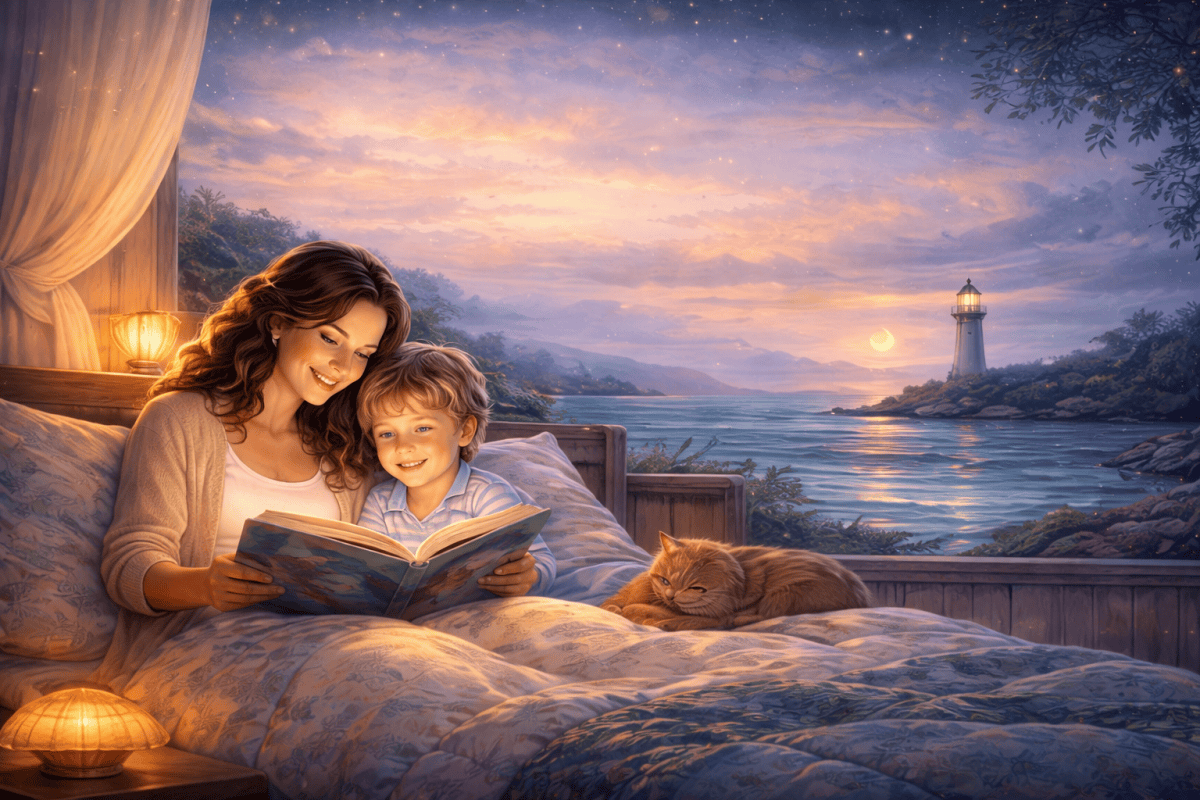
Why Reading at Bedtime Matters More Than You Think

A research-informed perspective for parents

There is something deceptively simple about reading a story at bedtime.

A book. A quiet voice. A child curled beside you.

Yet research in child development consistently shows that these moments are not just comforting rituals—they are foundational to how children learn to read, think, and understand the world.

As a primary school teacher, I see the long-term impact of these early experiences every day. The children who thrive in literacy are not always those who arrive already reading—but those who have been immersed in reading as a shared, meaningful experience.


Children begin learning to read long before they can decode words

One of the most important ideas in early literacy is that reading does not begin with phonics instruction. Instead, it develops gradually through what researchers call emergent literacy (Teale & Sulzby, 1986).

Emergent literacy recognises that children start building reading skills from infancy through everyday interactions—especially when they are read to.

Through bedtime reading, children begin to understand:

  • That print carries meaning
  • How books are structured
  • The rhythm and patterns of language
  • How stories are organised

Even before they can recognise letters, children are already constructing a mental model of what reading is.


Children learn through observation and modelling

Developmental psychology highlights that children learn not only through instruction, but through watching others.

Albert Bandura’s social learning theory (1977) emphasises that children acquire behaviours through observation and imitation. When a child watches a parent read—turning pages, using expression, engaging with the story—they are internalising what reading looks and feels like.

This is why many children will:

  • “Read” stories from memory
  • Mimic intonation and expression
  • Use narrative phrases in their speech

These behaviours are not incidental—they are early forms of literacy development.


Shared reading supports development within the child’s learning zone

Lev Vygotsky’s concept of the Zone of Proximal Development (1978) helps explain why reading together is so effective.

Children can understand far more complex language and ideas when supported by an adult than they can independently. During bedtime reading, the adult provides:

  • Vocabulary beyond the child’s current level
  • Explanations and context
  • Emotional cues and interpretation

This process—often called scaffolding—enables children to gradually internalise language and comprehension skills.


Language development is strengthened through story

A strong body of research shows that shared reading significantly enhances children’s language development.

Children who are regularly read to are exposed to a wider and richer vocabulary than in everyday conversation (Mol & Bus, 2011). Books introduce:

  • More complex sentence structures
  • Less common words
  • Rich descriptive language

Over time, this exposure supports both oral language development and later reading comprehension.


Reading together builds more than literacy—it builds relationships

While the cognitive benefits of reading are well documented, the emotional dimension is equally important.

Jerome Bruner (1983) emphasised that children learn language through meaningful social interactions. Bedtime reading provides a consistent, calm, one-to-one context in which children feel secure and engaged.

This emotional connection matters because:

  • It creates positive associations with books
  • It supports attention and engagement
  • It fosters a sense of safety and belonging

Children who associate reading with comfort and closeness are more likely to develop intrinsic motivation to read.


The long-term impact of shared reading

Research has consistently demonstrated that shared book reading is strongly linked to later reading success.

A meta-analysis by Bus, Van IJzendoorn, and Pellegrini (1995) found that children who experience regular shared reading show significant advantages in:

  • Language development
  • Early literacy skills
  • Reading achievement

Importantly, these benefits are cumulative. Small, consistent moments—like bedtime reading—build over time into substantial developmental gains.


What this means for parents

The evidence is clear:

You do not need to “teach” reading at bedtime.
You simply need to share it.

Even a short daily routine of reading together can:

  • Strengthen your child’s language skills
  • Build their understanding of stories
  • Support future reading success
  • Foster a lifelong love of books

It is not about perfection, performance, or pressure.

It is about presence.


A final thought

In the classroom, we often focus on what children can do—the words they can decode, the sounds they can recognise.

But long before that, something quieter is happening.

A child listens.
A child watches.
A child begins to understand that reading is something meaningful.

And often, that understanding begins at bedtime.


References

Bandura, A. (1977). Social Learning Theory. Englewood Cliffs, NJ: Prentice Hall.

Bruner, J. (1983). Child’s Talk: Learning to Use Language. Oxford: Oxford University Press.

Bus, A. G., Van IJzendoorn, M. H., & Pellegrini, A. D. (1995). Joint book reading makes for success in learning to read: A meta-analysis. Review of Educational Research, 65(1), 1–21.

Mol, S. E., & Bus, A. G. (2011). To read or not to read: A meta-analysis of print exposure from infancy to early adulthood. Psychological Bulletin, 137(2), 267–296.

Teale, W. H., & Sulzby, E. (1986). Emergent Literacy: Writing and Reading. Norwood, NJ: Ablex.

Vygotsky, L. S. (1978). Mind in Society: The Development of Higher Psychological Processes. Cambridge, MA: Harvard University Press.

Whitehurst, G. J., & Lonigan, C. J. (1998). Child development and emergent literacy. Child Development, 69(3), 848–872.

Listening to the Ocean: Björk’s Ecological Aesthetics and the Sea as Creative Presence

Introduction

For many artists working in coastal environments, the ocean is more than a landscape. It is a presence that shapes identity, sound, memory, and imagination. In contemporary art and music, few figures embody this relationship as powerfully as Björk. Across her career, Björk has consistently explored the relationship between humans and the natural world, drawing deeply on Iceland’s volcanic geology, oceanic climate, and ecological rhythms.

Her work offers a compelling example of what might be described as ecological aesthetics—an artistic approach in which natural systems are not merely subjects of representation but active collaborators in the creative process. Nowhere is this more evident than in her engagement with the ocean. From songs narrated by the sea itself to immersive visual installations inspired by natural phenomena, Björk’s practice suggests that the ocean can function as a creative witness, observing and shaping human culture while remaining fundamentally beyond it.

This idea resonates strongly within island cultures, where the sea forms both physical boundary and cultural lifeline. Through music, visual art, and digital media, Björk’s work offers an important case study in how contemporary artists translate marine environments into aesthetic experience.


The Ocean as Origin

Björk grew up in Reykjavík, a city surrounded by the North Atlantic. In interviews she has frequently described the sea as a formative presence in her life, stating that walking down to the ocean felt like returning home.

This connection reflects a broader aspect of Icelandic culture, where landscapes are experienced not as passive scenery but as living forces. The ocean shapes weather, economy, mythology, and daily life. In this context, artistic creativity often emerges from an intimate relationship with natural systems.

Rather than presenting nature as something separate from human culture, Björk’s work suggests a world in which human creativity emerges from ecological conditions. Sound, rhythm, and visual imagery frequently echo the cycles and energies of natural environments.


The Ocean as Voice

One of the most explicit examples of this relationship appears in the song Oceania, written for the opening ceremony of the 2004 Olympic Games.

Unlike traditional songs about the sea, Oceania is narrated by the ocean itself. The lyrics speak from the perspective of the primordial waters from which human life emerged:

“Your sweat is salty, I am why.”

Here the ocean becomes narrator, ancestor, and witness simultaneously. Humanity is framed not as separate from nature but as a continuation of marine life.

This perspective aligns with emerging ecological philosophies that challenge the traditional division between humans and the natural world. Instead, nature becomes a participant in cultural expression.


Ecological Systems and Artistic Practice

Björk’s interest in the relationship between art and natural systems became especially prominent in the project Biophilia.

The project combined music, visual design, education, and digital technology in an exploration of natural phenomena such as gravity, tectonic movement, and crystallisation. Custom-built musical instruments translated natural processes into sound, including devices that used pendulums and electromagnetic forces.

Through Biophilia, Björk proposed that artistic creativity and scientific observation share a common origin: curiosity about the patterns that shape the natural world.

In this sense, the project can be understood as an attempt to build a creative ecosystem, where art, science, and environment are intertwined.


Visual Art and Immersive Environments

Björk’s work increasingly moved beyond music into immersive visual art environments. The exhibition Björk Digitalpresented a series of virtual reality experiences that place viewers inside evolving natural and emotional landscapes.

These installations often evoke underwater environments, organic textures, and fluid biological forms. Rather than presenting nature as static imagery, the works immerse audiences within dynamic ecological systems.

Similarly, the major retrospective Björk retrospective exhibition at the Museum of Modern Art framed Björk’s career as a multidisciplinary artistic practice spanning music, film, costume design, technology, and installation.

This curatorial approach emphasised the way her work creates sensory environments, echoing the immersive experience of natural landscapes such as coastlines or volcanic terrain.


Soundscapes and Marine Imagination

Another important aspect of Björk’s practice is her attention to sound as a spatial and ecological phenomenon. Her compositions often incorporate layered vocal textures, environmental recordings, and unconventional instrumentation.

These sonic strategies mirror the structure of natural soundscapes, where multiple elements—wind, water, wildlife, and geological movement—combine to form complex acoustic environments.

In marine environments, sound plays a particularly significant role. Many ocean species rely on acoustic communication, and underwater sound travels vast distances. Artists working with ocean themes often draw inspiration from these acoustic properties.

Björk’s music frequently evokes this sense of spatial depth, creating sound environments that feel fluid, immersive, and organic.


Island Culture and Ocean Identity

The relationship between Björk’s work and the ocean can also be understood through the lens of island culture.

Island societies often develop distinctive cultural identities shaped by geographic isolation and maritime connection. The ocean is simultaneously barrier, resource, and symbolic horizon.

Artists emerging from these contexts frequently explore themes of:

  • migration
  • ecological awareness
  • weather and atmosphere
  • human vulnerability within natural systems

Björk’s work reflects many of these themes. Her artistic language often merges technological experimentation with deeply elemental imagery—lava, water, crystals, and biological structures.

This combination suggests an attempt to articulate a form of contemporary island cosmology, in which modern technology coexists with ancient ecological awareness.


The Ocean as Creative Witness

The idea of the ocean as a creative witness offers a useful framework for understanding Björk’s work.

Rather than depicting nature as scenery, this concept proposes that natural environments observe and shape human culture over time. The sea records histories of migration, trade, climate, and myth. Artists who engage deeply with marine environments often become interpreters of these layered histories.

Through music, visual art, and immersive technologies, Björk translates the sensory and emotional experience of living near the sea into artistic form. Her work invites audiences to listen more closely to the natural world and to recognise the ecological relationships that sustain human life.

In this sense, the ocean becomes not only a source of inspiration but a collaborator in creative practice.


Conclusion

Björk’s multidisciplinary work demonstrates how contemporary art can engage deeply with ecological systems and environmental awareness. By drawing on Iceland’s landscapes and marine environment, she has developed an artistic language that treats nature as a living presence within cultural expression.

Her exploration of soundscapes, immersive visuals, and natural phenomena suggests new ways of thinking about the relationship between creativity and ecology.

For artists working in coastal and island environments, her work offers an important example of how the ocean can function as both subject and witness—a force that shapes imagination, identity, and artistic practice.

Listening to the ocean, in this sense, becomes not simply an act of observation but a form of cultural dialogue.


Ocean Cry is an artist, writer, and musician exploring the relationship between the ocean, creativity, and island cultures. Drawing inspiration from natural soundscapes, alternative music, and coastal landscapes, the work moves between art, music, and writing to examine how the sea shapes identity, imagination, and wellbeing.

References

Academic

Björk related