Attention, Island Cultures, and Art as Witness
In a world increasingly shaped by screens, it is possible to forget how to look.
Digital devices connect us across vast distances, yet they can also draw our attention away from the landscapes directly in front of us. Social media feeds refresh endlessly, notifications interrupt moments of quiet, and algorithms determine much of what we see and read each day.
Against this background, something simple but profound can happen when attention returns to the physical world.
The sea, perhaps more than any other landscape, reminds us how to notice again.
The moment the rain was already falling
Recently I experienced a moment that crystallised this shift in awareness.
I was sitting at my desk beside a window, working on my computer, when a notification appeared on Facebook informing me that it was raining in my area. I looked at the screen, paused, and then turned my head toward the window.
It was raining.
The moment felt strangely disorientating. Technology had informed me of something that was already happening directly outside my window.
It was a small experience, but it revealed how easily digital mediation can replace direct perception.
In an age where information flows continuously through devices, it becomes possible to know about the world without actually observing it.
The digital attention economy
Over the past two decades, researchers have increasingly examined how digital technologies reshape patterns of human attention.
Many social media platforms operate within what scholars describe as the attention economy, where human focus becomes a valuable commodity (Davenport & Beck, 2001). Interfaces such as infinite scrolling feeds and intermittent notifications are designed to keep users engaged for as long as possible.
Technology ethicist Tristan Harris has argued that many digital systems are intentionally structured to exploit psychological vulnerabilities such as reward anticipation and social validation.
Media theorist Nicholas Carr suggests that these environments can encourage rapid scanning of information rather than sustained concentration. In The Shallows, Carr argues that constant exposure to fragmented information streams may reshape how people read, think, and process knowledge (Carr, 2010).
For many people, this shift becomes noticeable when attempting activities that require deeper attention—reading books, writing by hand, or spending extended time outdoors.
Following the sun
There was a time in my life when my relationship with time felt very different.
While living in Queensland, Australia, daily life often unfolded according to the movement of the sun rather than digital notifications or rigid schedules.
Morning began with light rising over the outback. Afternoons stretched long and warm beneath open skies. Evening arrived slowly as the sun dropped toward the horizon.
Time felt embodied.
Instead of checking devices for updates, the day revealed itself through subtle environmental changes—light shifting across the water, winds picking up along the coast, birds moving across the sky.
Living in this way demonstrated how attention can be anchored in landscape rather than technology.
Reading the sea: surfers and seafarers
Different coastal cultures often develop their own ways of reading the sea.
While living in Queensland, I spent time observing surfers and the rituals that shaped their relationship with the ocean. Surfers frequently arrived early and stood quietly at the shoreline before entering the water. They watched the horizon, studying the rhythm of incoming swells, the intervals between waves, and the direction of the wind.
What appeared casual was in fact a form of environmental literacy. Experienced surfers could predict how waves would break across reefs or sandbanks simply by studying the shape and timing of the swell.
The sea was not simply something to play in—it was something to read.
This form of embodied knowledge resonates strongly with maritime traditions in island communities.
In Shetland, conversations with local seafarers reveal similarly nuanced relationships with the ocean. Fishermen and sailors often describe how they can read the sea through subtle cues: the direction of the wind, the movement of tides, the behaviour of seabirds, or the position of the moon.
Lunar cycles, tidal movements, and atmospheric conditions have long shaped safe navigation and fishing practices. Such knowledge is rarely written down. Instead, it is learned gradually through observation and experience.
Anthropologist Tim Ingold describes this type of understanding as dwelling knowledge, a way of knowing that emerges from sustained engagement with an environment rather than abstract instruction (Ingold, 2000).
In both contexts—the surfer scanning the swell and the seafarer interpreting wind and tide—the ocean becomes a text that can be read by those who learn to pay attention.
Island cultures and ecological time
Island communities often cultivate particularly close relationships with surrounding environments.
Island studies scholar Godfrey Baldacchino notes that island societies frequently develop heightened environmental awareness because livelihoods are closely tied to land and sea systems (Baldacchino, 2007).
In maritime cultures such as Shetland, fishing, crofting, and seafaring historically required detailed observation of weather patterns, tidal movements, and ocean conditions.
Pacific scholar Epeli Hauʻofa offers a powerful interpretation of this relationship. In Our Sea of Islands, Hauʻofa argues that Pacific Islanders historically understood the ocean not as empty space separating islands but as a cultural network connecting communities across vast distances (Hauʻofa, 1994).
Within this worldview, the ocean becomes both environment and knowledge system.
Tides, currents, winds, and stars carry information. Attention becomes ecological rather than technological.
Art as environmental witness
Art can play an important role in documenting these relationships between people and place.
Environmental humanities scholar T. J. Demos describes contemporary ecological art as a form of environmental witnessing, where artistic practices document ecological realities and invite reflection on environmental futures (Demos, 2016).
Artists working in coastal environments frequently record subtle changes in landscapes, weather patterns, wildlife, and human interaction with the sea.
Photography, painting, sound recording, and film can function as sensory archives of place.
Practice-led research scholar Linda Candy argues that creative practice can itself produce knowledge. Through observation and reflection, artists generate insights that complement traditional academic research (Candy & Edmonds, 2018).
In this sense, art becomes a way of paying attention.
Photographing the same beach across seasons, for example, can reveal shifting light, tidal patterns, and changing weather. Recording the sound of waves or seabirds captures atmospheric qualities that written description alone cannot convey.
Such practices create forms of environmental memory.
Attention restoration and the ocean
Psychological research also suggests that natural environments can help restore cognitive focus.
Environmental psychologists Rachel Kaplan and Stephen Kaplan developed Attention Restoration Theory, proposing that exposure to natural landscapes can replenish mental resources depleted by sustained directed attention (Kaplan & Kaplan, 1989).
More recent studies suggest that time spent in natural environments can reduce stress and improve cognitive functioning (Bratman et al., 2015).
Coastal landscapes appear particularly effective in this regard. The rhythmic movement of waves, expansive horizons, and multisensory qualities of marine environments create conditions that encourage contemplation and relaxation.
The ocean as a teacher of attention
The ocean teaches attention differently from digital systems.
Digital platforms operate through speed and novelty. Feeds refresh constantly, encouraging rapid shifts in focus.
The sea moves according to different rhythms.
Tides rise and fall over hours. Weather systems develop over days. Ecological changes unfold across seasons.
Sociologist Hartmut Rosa describes modern life as characterised by social acceleration, where technological systems continually increase the pace of communication and activity (Rosa, 2013).
Natural environments, however, can offer what Rosa calls resonance—moments of meaningful connection with the world.
Watching waves roll toward shore or observing seabirds navigating coastal winds invites a slower form of awareness.
The sea does not demand attention. It invites it.
Looking up again
Technology itself is not inherently harmful. Digital tools can support creativity, connection, and accessibility when used intentionally.
Yet when screens begin to replace direct experience of the world around us, something essential may be lost.
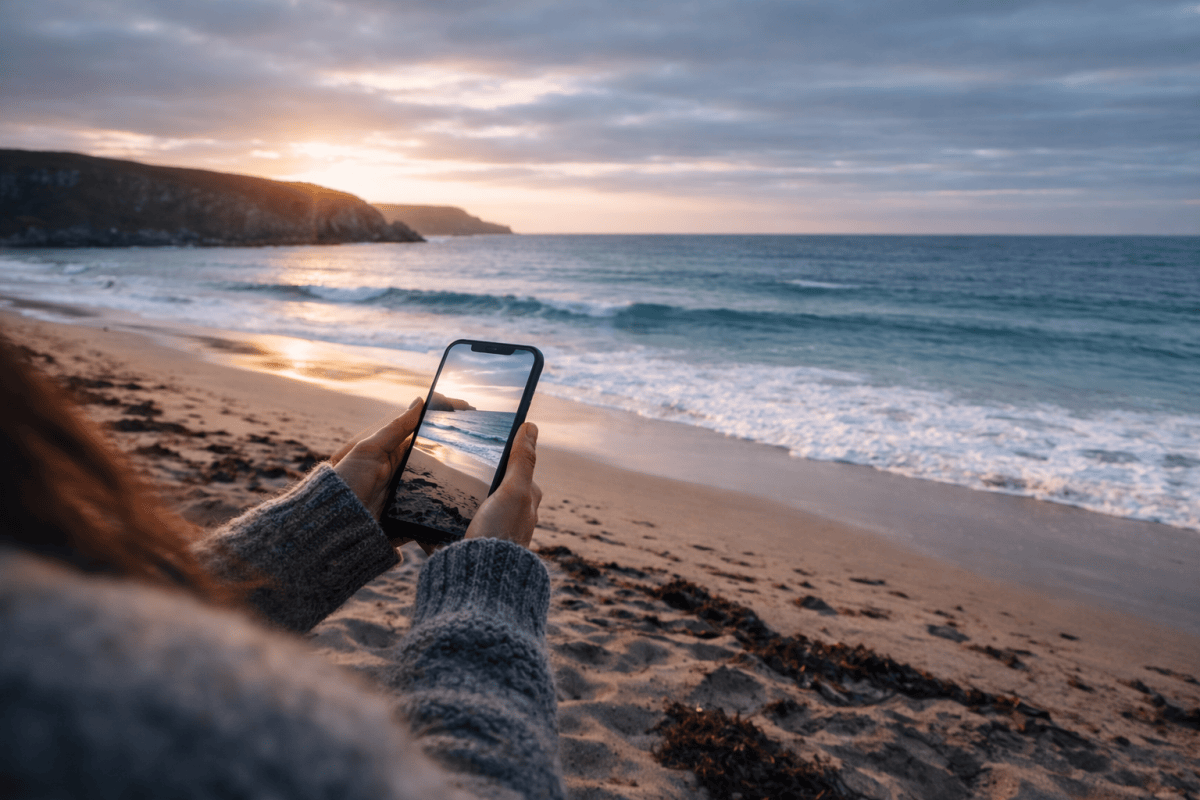
Sometimes the most radical act is simply to look up. So I’ve decided to create #lookup – a movement to remind us to ditch the screen for a while and get back into nature:
To notice the rain without needing a notification.
To watch the tide instead of the timeline.
The ocean does not compete for attention.
It does not flash alerts or refresh its feed.
It moves with rhythms that existed long before digital networks and will continue long after them.
In a world of constant scrolling, the ocean reminds us how to look again.
References
Baldacchino, G. (2007). A World of Islands: An Island Studies Reader.
Bratman, G., Hamilton, J., & Daily, G. (2015). The impacts of nature experience on human cognitive function and mental health. Annals of the New York Academy of Sciences.
Candy, L., & Edmonds, E. (2018). Practice-Based Research in the Creative Arts.
Carr, N. (2010). The Shallows.
Crary, J. (2013). 24/7: Late Capitalism and the Ends of Sleep.
Davenport, T., & Beck, J. (2001). The Attention Economy.
Demos, T. J. (2016). Decolonizing Nature.
Harris, T. (2016). How Technology Hijacks People’s Minds.
Hauʻofa, E. (1994). Our Sea of Islands.
Ingold, T. (2000). The Perception of the Environment.
Kaplan, R., & Kaplan, S. (1989). The Experience of Nature.
Morton, T. (2010). The Ecological Thought.
Newport, C. (2019). Digital Minimalism.
Rosa, H. (2013). Social Acceleration.
Andrea Bibby (Ocean Cry) is an artist, writer, and publisher based in Shetland. Her work explores the relationship between ocean environments, cultural identity, and human wellbeing through art, writing, and practice-led research. Through Ocean Cry she examines how coastal landscapes shape attention, creativity, and ecological awareness.

 Urban Viking